the two tailed spider
The two tailed spiders are called so because their rear spinnerets are longer than usual, and appear like tails. Spinnerets are the organs with which the spiders spin their silk. In the picture below, you can see the tail pair of spinnerets kept together in its rear. Legs, except the third pair, are very long and slender and have banded colors.
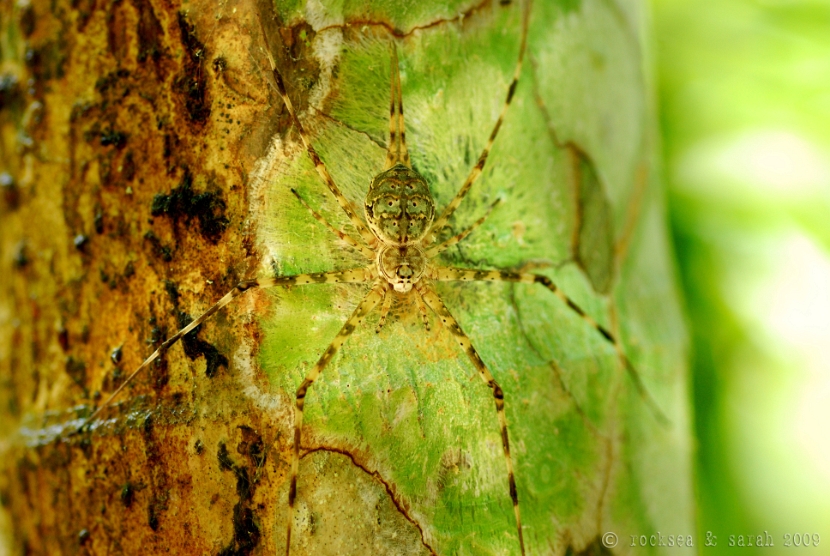
These spiders are masters of camouflage. Their body coloring is usually brownish, matching with the dry barks, and they change their color according to the surface they are resting on (like these crab spiders). Apart from this, they have a thin flat abdomen, and they lie sticking to the bark as if a part of it. This one, of the hersilia svignyi species, was resting on our garden palm tree, and I found it accidentally, probably when it moved. This particular species is common along South India/Asia.
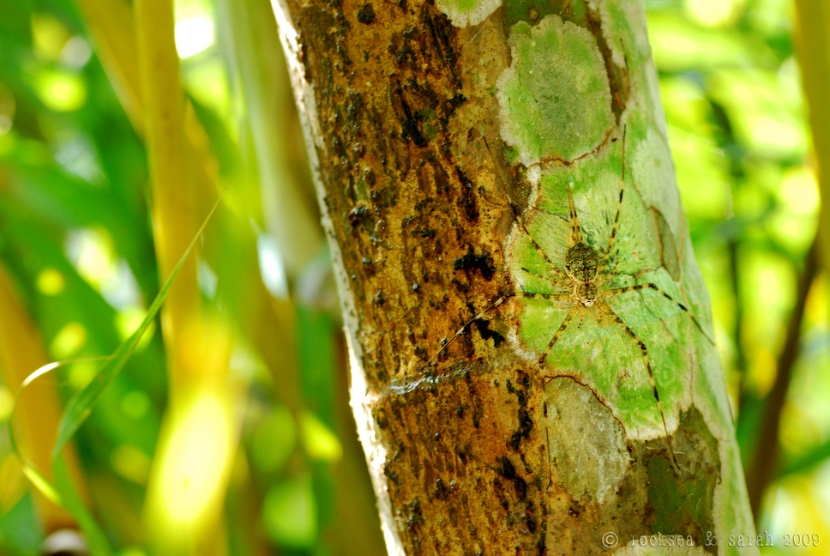
The two tailed spiders hunt insects which come close to them. The species shown here hunts by throwing the silk on their prey, and running around it depositing the silk, confining the prey.
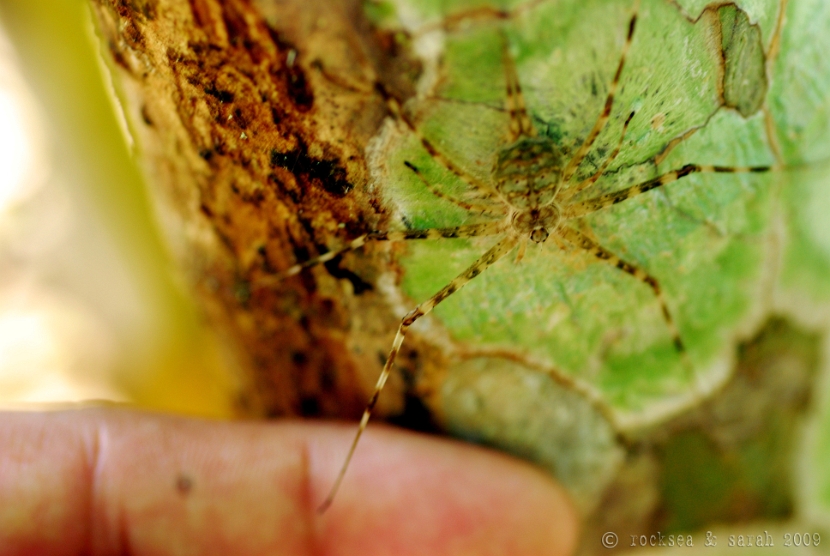
They are harmless, you see 😉 When disturbed, the spider moves to the opposite side of the tree.
Date: 13 Oct 2007
Location: @ home, Kottayam, Kerala, India
Camera: Nikon D80 + Tamron SP AF90mm f/2.8 Di Macro Lens
Reference:
1. B. J. Kaston, 1965: Some Little Known Aspects of Spider Behavior, American Midland Naturalist, 73, 2, 336-356.
2. Department of Zoology, Sacred Heart College, Cochin, Kerala [southindianspiders.com]



The best thing is that u hv so much information with the lovely pics too! Awesome 🙂
Buon Anno! Scorpio, Lakshmi, Indrani, Bindu, Ashwin 🙂
the new blogspot I meant..sorry forgot to specify!
🙂
Hi Roxy,
For once a spider has awed me instead of irking me out!
Fantastic..
Ive tried to click some pics too of nature’s beauty around..defnitely not as amazin a job as urs but still..
plz do visit my blog!
🙂
Tc
Vibhuti
Vibhuti, wonderful birding! I remember the days when i started bird watching, it was so enthralling!
Seasons greetings Rocksea! Hoping that 2010 brings a lot of happiness to you and your family and many interesting posts to your blog!
They are gorgeous! And how well they blend into their background!
hmmm..i have seen a species of spiders with 2 claw like legs(?) in the front too.. it resembles a scorpions claws in the front.. wonder what it might be …
flyaway, those 2 claw like parts are called pedipalps or palps. Spiders and scorpions belong to the same group called arachnids. Scorpions have the palps developed as claws, for catching their prey. Spiders have them like small sensors scrutinizing other objects. I guess some of them use these palps for catching prey too. It seems male spiders use these palps for mating also.
Buon Anno! 🙂
hmmm..i have seen spiders with 2 legs(?) in the front too..
it resembles a scorpions claws in the front..
wonder what it might be …
I wish you and all your loved ones a Very Happy and a Safe 2010!
Happy New Year Folks !
Have a wonderful year ahead! 🙂
Happy new year to Rocksea, Sarah and Pratyahara! 🙂
manjunath, laura, 🙂 grazie e buon natale
Another lovely animal… great shots 😉
Cool man…….. just browsed through your blog pictures are amazingly vivid and crisp
Seasons Greetings !
As usual you amaze me with this lovely shot. I tried capturing a green beetle I found in my room but the end result was a disaster and insult to the creature 😀
i guess inside our rooms they look out of place hehe. keep trying, will get better with time!
Dagny, Aniruddha, Andy,
🙂 Thanks, and Wishes 😀
Wow amazing how they change colors depending on the surface. Great set especially liked the last one where you are shaking hands with the spider! 🙂
Nice pics.Why is the third pair of legs smaller? A merry X’mas and happy New year to roxy,sarah and baby pratyahara.
Probably for clinging on to the branches, providing stability while the other legs are used for jumping, running etc. I couldn’t find definitive information regarding this species. But some other species have shorter pairs for such purposes.
Season’s greetings to you from all of us 🙂
Roxy, Juby & Pratya
your blog is really informative and beautiful, stunning photographs! thanks for visiting 🙂
Fantastic Shot and a vivid description…..excellent narrative!!!
OMG! Very brave to have shaken hands with the spider. I have taken shots from a distance always. 😛
Great informative post.
should say the spider was brave enough to stay calm and trust that its camouflage will save it 😀
Superb shots.. nd only you can make us look at a spider with awe!
Frankly am hearing the word spinnerets the first time.. never really knew how they did their job….
nd Sarah says it is a “She” .. nd how do u infer that?
oh, sarah might have mentioned it in a general way, refering to the movie “charlotte’s web”, where a spider is one of the main characters. Still, I guess this is a female due to its size. Males are almost half the size of females. Females of this species grow up to 8-10 mm, while the males make it to 5-8 mm.
kanak, srilatha, sandeep, joshi, abhilash:
🙂
and season’s greetings
Happy new year to you and your family Roxy.
The spider looks nice. I have seen several spiders that can also never be noticed due t their nature of changing colours.
Happy Christmas Roxy.
beautiful colors and loved the camouflage! merry christmas!
they look like a 10 legged spider … actually. and the camouflage is evident in the greenish tinge to the spidey! amazing.
gr8 shots as always
Like always .. Superb Shots !!!
I like the info that comes with every post of yours !!
Superb shots! And such a pretty spider too. I’ve never observed such details but now I know what to look for!
But that much search indicates deep interest, is it linked with your profession too, just curious.
hehe yes, too much interest in prakriti and its magic 🙂 my profession is totally different, but that might have helped in giving a scientific backup 😉
reminds me of charlotte… :D. Of course this lady is way prettier in these shots.
The tales are so matching with the legs.
And my question is same as Mridula’s. I know you can say it’s all there on web but how do you know what to search for?
Observations, primarily. Supplemented with info from scientific journals [via google scholar] and specific group email discussions [yahoo, google].
🙂
Not only the pictures are great your write up is also so informative. How do you know so much about the species?
Hey mridula, some of the information are from observations alone. I feel that is important for providing new and original content. These are usually supplemented with information gathered from discussion groups [yahoo, google] on Indian butterflies, moths, spiders, etc. Other than this, there are scientific journals available through google scholar, which I depend on for specific information. For example, the silk throwing info is from a scientific paper [reference given].
Great capture as always! Seriously, i feel the same as Gyanban has said above 🙂
🙂 thanks mohan, greetings of the season
This is a super shot – you might want to talk to natGeo !
🙂 thanks Gyan