India; Unity in Diversity
Namaste.
Yesterday (29 Oct, 2005) I had gone to talk about India at an English Seminar for high school students at SIT school.
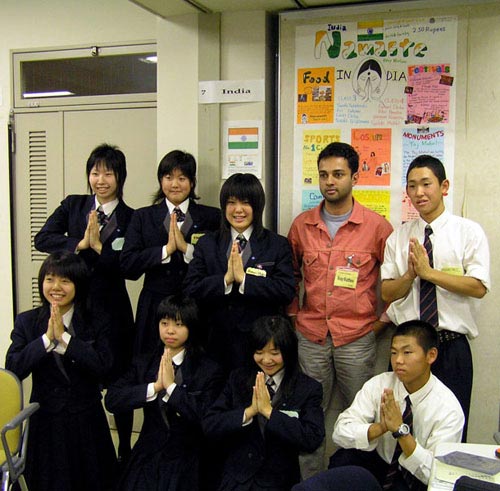
Thought I would share the slides and some info with you as well. The slides have been made as simple as possible, for the students to digest and may be I will append some extra info for you. Will put one or two slides per day.
Namaste
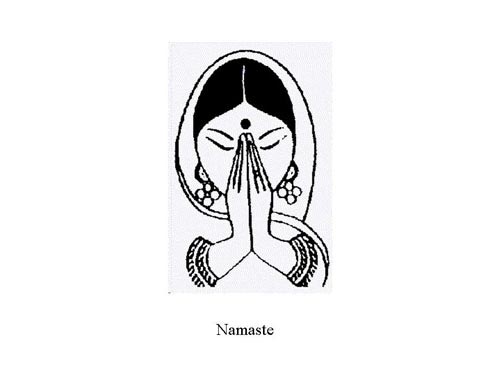
Namaste: नमसà¥à¤¤à¥‡:
In Sanskrit “Namas” means, “bow, obeisance, reverential salutation.” It comes from the root Nam, which carries meanings of bending, bowing, humbly submitting and becoming silent. “Te” means “to you.” Thus “namaste” means “I bow to you.” the act of greeting is called “Namaskaram,” “Namaskara” and “Namaskar” in the varied languages of the subcontinent.
In simple language, namaste is “a hello with a respect”.
Namaste can be related to the Japanese bowing. In both, we don’t touch the other person as in the western style of shaking hands of each other. Both gives respect and means “I bow to you”.
In my state, Kerala we say ‘Namaskar’ instead of Namaste.
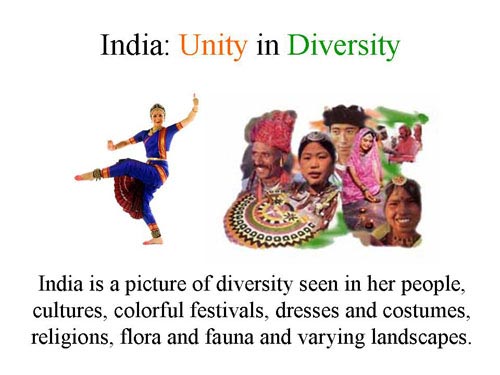
India: Unity in Diversity
India: Brief Satistics
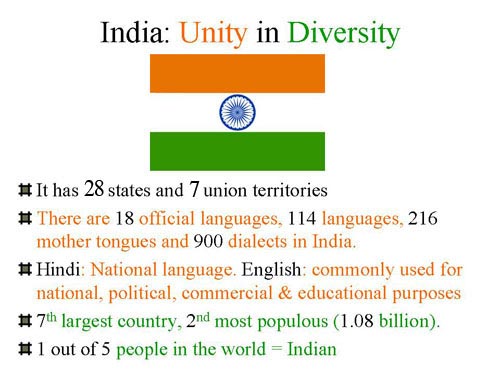
Yeah. The country is so diverse! Many languages, religions, costumes flourish in India. Even the division into states are basically according to this cultural/language diversity. Most of the states have its own language.
eg: Language of the state of Kerala = Malayalam.
Hindi is the national language. English has associate status and is widely used.
Herez a list I got from Wikipidea, on the major languages:
- Hindi हिनà¥à¤¦à¥€
- English (associate official)
Recognized national languages of India (Scheduled list for official use)
- Assamese (official language of Assam) অসমীয়া
- Bengali (official language of Tripura and West Bengal) বাংলা
- Bodo (official language of Assam)
- Dogri (official language of Jammu and Kashmir)
- Gujarati (official language of Dadra and Nagar Haveli, Daman and Diu, and Gujarat) ગà«àªœàª°àª¾àª¤à«€
- Hindi (official language of Andaman and Nicobar Islands, Bihar, Chandigarh, Chhattisgarh, Delhi, Haryana, Himachal Pradesh, Jharkhand, Madhya Pradesh, Rajasthan, Uttar Pradesh and Uttaranchal) हिनà¥à¤¦à¥€
- Kannada (official language of Karnataka) ಕನà³à²¨à²¡
- Kashmiri
- Konkani (official language of Goa)
- Maithili (official language of Bihar)
- Malayalam (official language of Kerala and Lakshadweep) മലയാളം
- Manipuri (Meithei) (official language of Manipur)
- Marathi (official language of Maharashtra) मराठी
- Nepali (official language of Sikkim)
- Oriya (official language of Orissa) ଓàœà¬¿à¬†
- Punjabi (official language of Punjab) ਪੰਜਾਬੀ, پنجابی
- Sanskrit संसà¥à¤•à¥ƒà¤¤à¤¾
- Santali
- Sindhi سنڌي، سندھی, सिनà¥à¤§à¥€
- Tamil (official language of Tamil Nadu and Pondicherry) தமிழà¯
- Telugu (official language of Andhra Pradesh) తెలà±à°—à±
- Urdu (official language of Jammu and Kashmir) اردو
Other popular languages of India
(over 5 million speakers but no official status)
- Awadhi (often considered a sub-variety of Hindi)
- Bhili (Bhil tribals)
- Bhojpuri (language of Bihar, often considered a sub-variety of Hindi)
- Bundeli (often considered a sub-variety of Hindi)
- Chhattisgarhi (language of Chhattisgarh, often considered a sub-variety of Hindi)
- Gondi (Gond tribals)
- Hariyanavi (Haryanvi) (language of Haryana, often considered a sub-variety of Hindi)
- Hindustani (A mixture of Hindi and Urdu. Spoken largely in the Northern part of India.)
- Kanauji (language of Uttar Pradesh, often considered a sub-variety of Hindi)
- Kodava, spoken in the Kodagu district of Karnataka
- Kutchi (language of Kutch, a region in Gujarat)
- Magadhi (language of southern Bihar, often considered a sub-variety of Hindi)
- Marwari (language of Rajasthan, often considered a sub-variety of Hindi)
- Tulu (spoken by Tulu people of Karnataka and Kerala)
Indian Flag:
The orange (deep saffron) symbolizes courage and sacrifice (saffron is the sacred color of Hinduism).
The white stands for peace, unity and truth.
The green stands for faith (Islam) and fertility.
The wheel in navy blue indicate the Dharma Chakra, the wheel of law in the Sarnath Lion Capital. The blue symbolizes the sky and the ocean. The 24 lines inside the chakra (wheel) symbolizes 24 hours of the day.


Hi I am sso thrillked I found your blog, I really found you by mistake,
while I wass looking on Diggg for something else, Regardless I am here
now and would just like tto say thank you for a maarvelous post and a all round interesting blog (I also love the theme/design), I don’t have time to read it all at the moment but I
have book-marked it and also added in your RSS
feeds, so when I have ttime Iwill be baack to read more,
Please do keep up the superb work.
my web-site zija Moringa tea
and im studying in an indian school
hi
iam proud to be an indian
proud to be an Indian !!!!!
you did nice it also helps for many schools.
I PROUD TO BE A INDIAN
Hi Rocksea,
I used your “India; Unity in Diversity” as a presentation in my daughter’s culture program… to teach all the kids about India…
This is really nicely done…
Thanks
I love my INDIA & i am proud to be an Indian.
Well written. Proud to be an Indian
I LIKE INDIA
i LOVE INDIA
INDIA is the king of this world and i am proud to be an Indian ….!!!
JAI HIND JAI HIND VANDAE MATHARAM VANDAE MATHARAM JANA GANA MANA YOU ARE A MUNNA
pics are great!helped me.thanks
Remove inequality from India
Jai..Hind..
Really nice..in a simple form. The information can be extended for more better approach like Crops, Occupation etc.
There are lots of things that can be shared about India with so much pride, Your effort to publish those valuable facts about India needs mush appreciation. The effort of publishing about India will be endless.
it is very awesome…i really feel proud to be an indian ofcourse every indian do feel dat…but i wish to congratulate u for spreading india’s greatness to the world by taking a initiative by telling ur frns firstly abt our country….hope u have gud tyms in the future..n it was nyc meeting u..buh byee…hav a gr8 day
JAI HIND
It is a very good description to read about unity in diversity,but I wanted something to write about the topic.
nice job done…jai hind
Hi,
I have used your image in this article and credited you.
Thank you.
http://satyastories.wordpress.com/2009/05/31/your-neighbours-are-not-from-your-tribe-globalization-fall-out/
If you object, I shall remove it.
Regards,
Satya
I love India
I am proud to be an Indian
i love india…….
I AM PROUD TO BE AN INDIAN
JAY HIND
ok……….very nice site
nice……very very nice……you had a good job i am proud to be indian. J A I H I N D