Also known as : Double running stitch, Line stitch, Two-sided Line stitch, Two-sided Stroke stitch, Square stitch, Chiara stitch
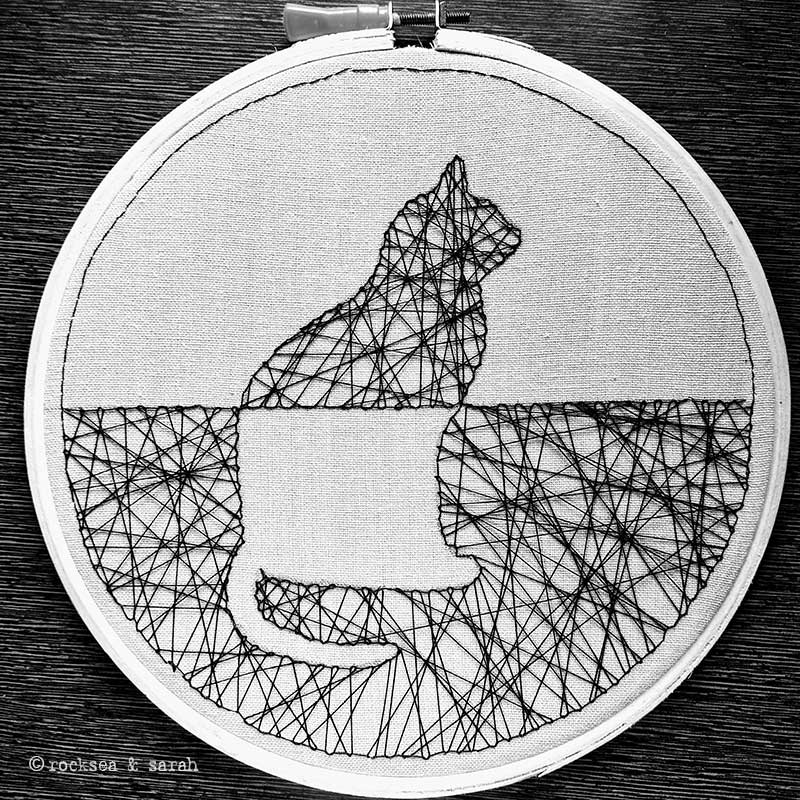
This stitch follows a pattern where a running stitch is done and the gaps between this running stitch is filled during a return journey of the needle and thread. This causes the stitch to bring out identical patterns on either sides of the cloth.
Looking at the history of it, holbein stitch derives its name from Hans Holbein the younger, who was a German artist. He was a portrait painter of the 16th century, who is more known to have painted Henry VIII and his children wearing clothing with ‘blackwork embroidery’.
Holbein stitch is widely used in Blackwork Embroidery and Assissi Embroidery as well. We can widely see it in cross stitch patterns too. This is because holbein stitch is a form of counted thread stitch.
Black work is again commonly known as spanish work. Catherine of Aragon was the wife of Henry VIII. She is believed to have brought garments in to England from Spain and they had black work on them. Black work is done using only black thread.
Assissi embroidery originated from Italy at around 13th and 14th century. It is a combination of black work, or holbein stitch and cross stitch. Traditionally Assissi embroidery employed only holbein stitch, but later, it incorporated varities of cross stitches as well. Assissi embroidery is not confined to a single thread color but uses different threads.
I have done two variations of the holbein stitch. This will help understand the technique.
![]() |
||
| Fig 1: Lay a base of running stitch. | ||
![]() |
Fig 2: Now, start a return journey with the same working thread. As, shown in this illustration, the return journey of running stitch will fill the gaps made during the first onward journey. You can use a different colored thread for creative effects. |
|
![]() |
||
| Fig 3: A finished line of holbein stitch would look like this. | ||
Variation 2:
![]() |
![]() |
|
| Fig 1: Follow the alphabets to make a step of running stitches along the four stitch lines. Note that all the stitches would be horizontal. | Fig 2: Do a return journey by filling up the gaps left by teh first onward journey of the running stitch. This time all the stitches would be vertical. You can use a different colored thread fro the return journey for a more creative holbein stitch. |
|
![]() |
||
| Fig 3: A finished ‘temple’ design using holbein stitch would look like this. | ||
Tags: chiara stitch, double running stitch, embroidery tutorials, hand embroidery, hand embroidery tutorials, hans holbein, holbein stitch, kasuti, kasuti work, line stitch, running stitch, running stitch family, running stitch variants, square stitch, two-sided line stitch, two-sided stroke stitch


Do you have patterns I can download for free which are designed to use the holbein or double-running stitch?
Dear Denise,
Thanks for dropping by. I do have a few patterns designed for using only holbein stitch. I will be putting them up my website in a few weeks, as it is a part of my tutorial. These patterns are a part of an ethnic indian embroidery called Kasuti work, and will be free to download.
If you require the patterns now, you can probably search for a few free patterns online under ‘Blackwork’. You Blackwork uses holbein stitch and can be done well over even weave cloth.
Hai Sarah,
I have done this work when studying in school. I’ve done it with the horizontal & vertical stitches in 2 different colours… that looks really nice…..
I just started browsing your site… Very organized… Me and my friend started learning the hand embroidery stitches for the last few weeks…. So we found this site is very helpful for us….
Congrats….
Dear Jisha,
Nice to know that you have done this in school.
Feels nice that our pages has helped us in your interest in hand embroidery. Do let us know if you are looking for any particular stitch or embroidery style.