chaityas of ajanta caves
Chaityas are buddhist prayer halls that house a stupa. The word chaitya has its roots in sanskrit chita ~ meaning a pyre or a pile of ashes. The ancient rock-cut buddhist caves of Ajanta were built during the 2nd century BC ~ 6th century AD. All these caves and sculptures are carved out of the rocky hills of Ajanta. They start carving from top of the hill and reach the bottom, and hence do not make use of scaffolds for support.
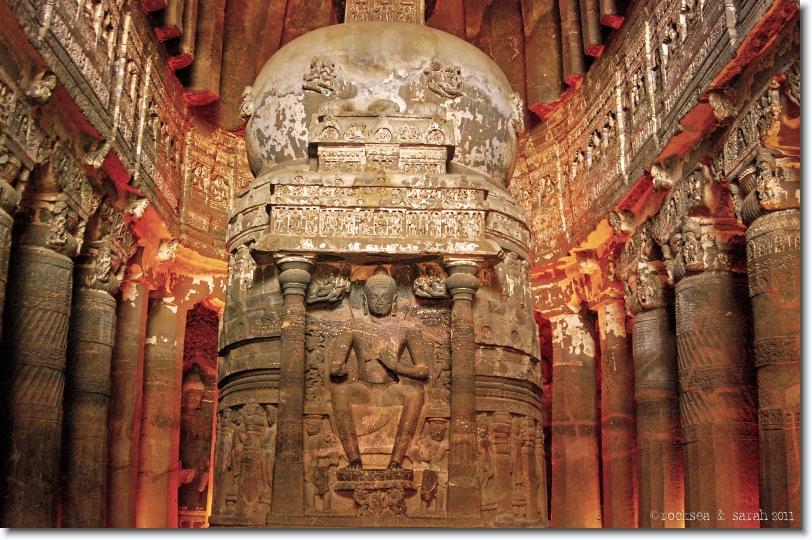
In the next four chaitya images, you can see how buddhism evolved during the period, from the early hinayana style to the mahayana style of buddhism. Out of the 30 caves of ajanta, 9, 10, 19, 26 and 29 are chaitya grihas and the remaining caves are viharas, carved out of a horse-shoe shaped rock-cliff valley.
Ajanta Cave 10. Thought to be the oldest chaitya hall at Ajanta (2nd century BC). During the early hinayana period, stupa is the centrepiece and no idols are revered.
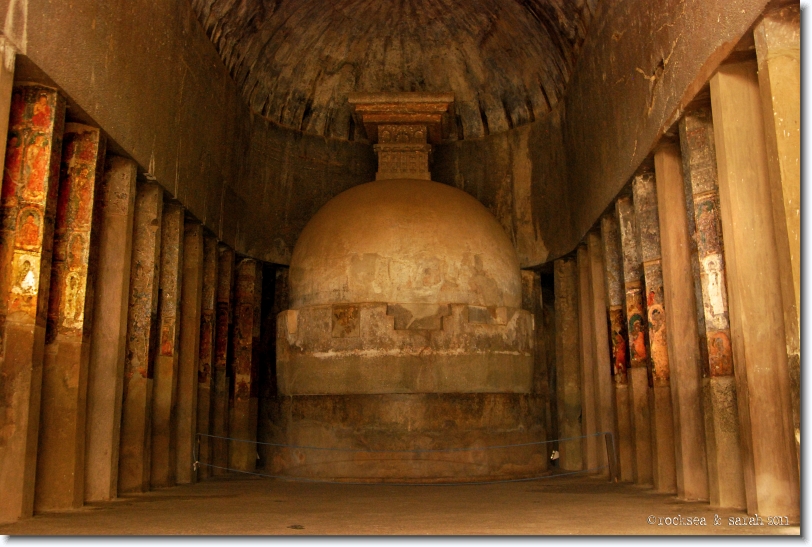
Ajanta Cave 9.
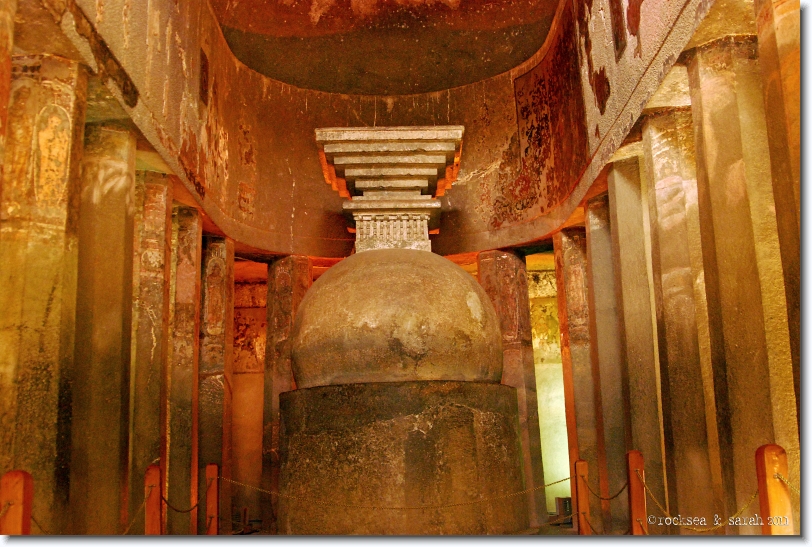
During the late mahayana period, chaitya has the buddha as the centrepiece, and idol worship is more prevelant. This is one of the most significant differences between these two periods, were relic worship was replaced by iconography.
Ajanta Cave 19. In the chaitya below, the buddha is seen with the stupa, probably refering to a transition from the hinayana to the mahayana style of buddhism.
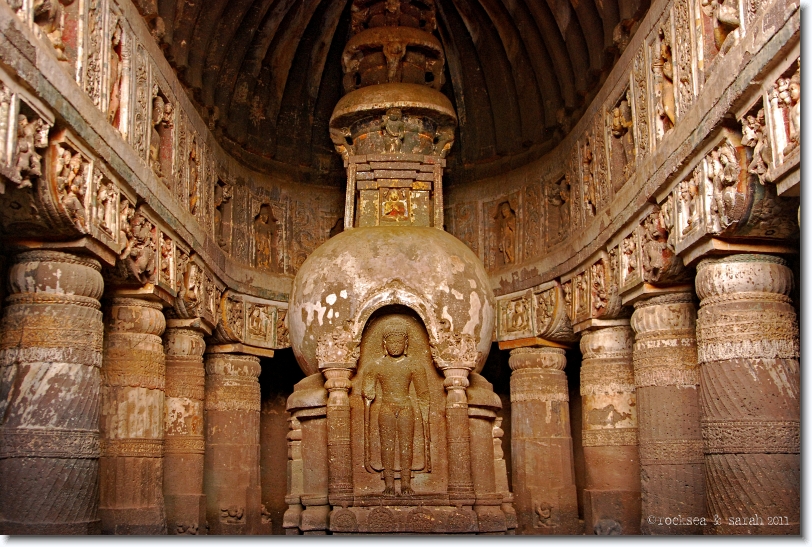
Ajanta Cave 26. Chaitya Hall with Buddha seated with his feet down.
Location of some of the ancient rock-cut buddhist caves in Maharashtra:
Karla Caves, Maharashtra, India
Ellora Caves, Maharashtra, India
Ajanta Caves, Ajanta, Maharashtra, India
Bedsa Caves, Maharashtra, India
Elephanta Caves, Maharashtra, India
Bhaja Caves, Maharashtra, India
For comparison, the chaityas from Bedsa and Karla are given below.
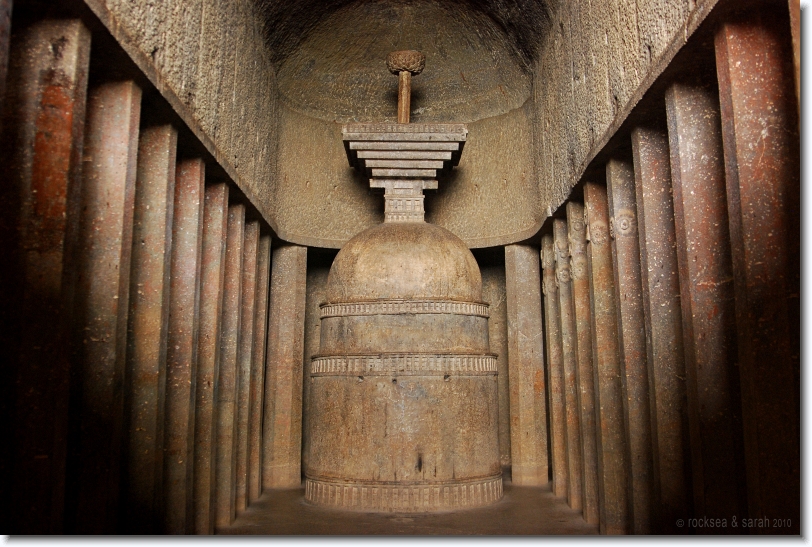
Chaitya at Bedsa. Simple chaitya hall with few decorations representing the initial style of architecture pertaining to Hinayana period.
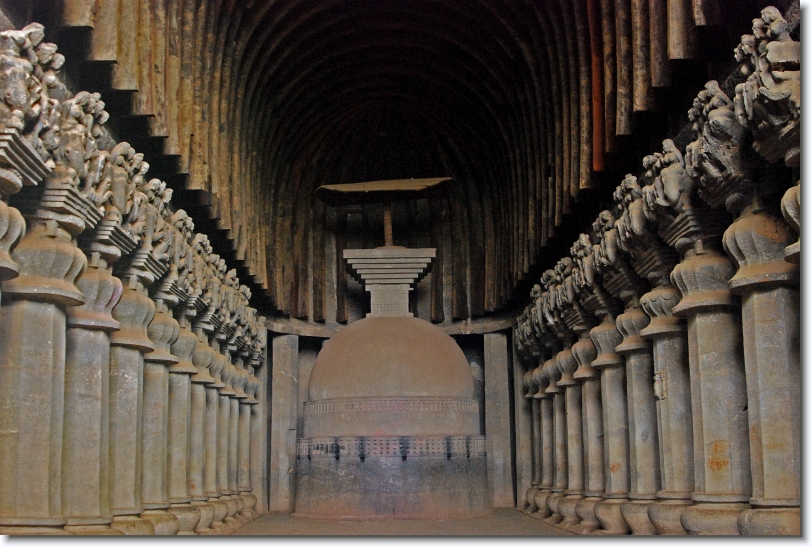
Chaitya at Karle. Gigantic hall with high vaulted roof, with a lot of sculpture work on the pillars and the entrance, though the stupa is plain as in hinayana style.
stupa: a dome-shaped structure, containing buddhist relics, used as a place of worship.




“Agni The Hindu God of Fire- Tibetan Buddhist Encyclopedia” It’s one thing for me to make
comments and observations on my own. It’s something more significant when some of my comments are affirmed by their inclusion in the Tibetan Buddhist Encyclopedia.
Google: “Ancient Gandhara Stupa Images” for exterior images of these stupas. Do you
see similarities with the exteriors of “Church Rock Utah” as well as “Mexican Hat Rock” in North America with the Gandhara Stupa
exteriors? Is the sole rock remaining on the
top of Mexican Hat Rock actually the last remaining Chatra of several that originally
adorned the top of a Gandhara Stupa there?
Make up your own mind whether or not Church Rock, Utah could possibly be a Stupa in the Sri Lanka style wrapped in 3 of the 5 colors of Buddhism.
Google: “Drone Videos of Church Rock, Utah” The one titled ‘Insane Spot Landing on the Top of Church Rock’ is particularly informative. That video also clearly shows the creek that runs past Church Rock and the man made water diversion channel that still brings water in to the rock/Stupa itself. “Church Rock: Cathedral in the Desert”
“Wrapped Buddhist Stupa/s in Sri Lanka & Utah?”
Use your favorite search engine: “Church Rock: Cathedral in the Desert”
Personally I am a Christian by faith and not Buddhist. But I can say that over many thousands of years the Lion’s Roar has most often been a strong but silent demonstration
of Buddhist teachings that were created to last and last and last. They have done exactly what they were intended to do and they largely exist today except for those that have been purposely destroyed by man.
The teaching of living a “Balanced Life” is one of Buddhism’s main purposes. Huge formations of balanced rock formations which they have created have accomplished their original purpose of that work. “Balanced Rock Formations Worldwide” This has been accomplished in my opinion by the enormous rock Chatras and Torana that can been found
to this day in Europe, Africa, N America etc. and the rest of the world.
Recently I found a different example of a Mushroom (Umbrella) Rock Chatra in China on the grounds of a mountain top Buddhist temple: “Hongyun Golden Summit at the top of Mount Fanjing” In this case the top portion of that rock has been moved at sometime in history. That’s unusual but not unique: “Queen Nefertari Rock Arches National Park, Utah” and lastly “Large Balanced Stone Column, Novia Scotia” All of these three large stone formations have been somehow moved either by nature or by man. I’m of the belief that it was by man (Buddhists) to shock and awe those who would see it for a long time after the clerics originally did their work to teach the importance of balance to others in the process.
I could be wrong but I don’t believe so. There is just far too much rock carved evidence of
ancient Buddhist worship symbols spread all over the world to think otherwise.
You must ask yourself why are there so many Rock Carved Arches (Toranas)and Mushrooms Shaped Rocks (Chatra) spread all around the world. Could it possibly be natural? I believe not.
Roxy, From your research images that you’ve posted we understand that Buddhists have had a fondness for carving oftentimes enormous rock structures. We also know that for some reason elephants were one of the images that these temple carvers had a particular fondness to carve. We know that by the number of elephants that simply show up on temples in India. So we know that several ancient religions from India loved to carve rock with elephants being right near the top of their list of images to carve.
Why is it then that if you search “Huge Rock Carved Elephants Worldwide” you will see pictures from all over the world that can hardly be seen as anything other than rock carved images of huge elephants? Buddhists have never been credited for ever having traveled to many of these locations. However, who else could it have been if these are indeed rock carved elephants images. These are found in N America, Africa and numerous other places around our planet. If these are in fact not erosion as we are told to believe, who other than Buddhists had the skills and desire to create these forms where they still show up to this very day.
In my opinion stone carved remains of ancient Hindu and Buddhist worship symbols are found not only in India, Pakistan and China but also in North America as well as many other locations around the world where ancient Buddhist missionaries traveled to share their faith to other cultures. Carved rock lasts a long time and I believe that is why these ancient missionaries used carved rock not only in India and other places in Asia but also wherever they traveled around the world. Examples of stone carved Buddhist Toranas, Chattras and Phallic Symbols are to be found all over not only in the North America Pacific Southwest but now also in California as well. I just recently came across a new smaller arch which you can access as Fremont Canyon Yosemite of Orange County Arch. It’s what I believe was once used by the locals for religious purposes as a Torana, Temple Gateway Arch. It’s a stand alone arch all by itself in a once remote area of California. It’s similar to numerous other stone arches such as Delicate Arch, Utah, Anasazi Arch New Mexico, Corana Arch and Rainbow Bridge which is still used to this day for religious purposes by the Native Americas matriarchal tribal cultures in that area. In my opinion ancient Vedic and Tibetan Buddhist Toranas can also be found through that Pacific Southwest in significant numbers. One that is still used to this day by the Hopi culture is Snake Dancers Rock in Walpi Village 3rd Mesa. This Chatra is used for the celebration of the once every two years Snake Dance that has been attended by at least one American President. The most visited collection of Chatras is located in a state park in Kansas called Mushroom Rock State Park. Images of that park and the uniquely shaped rocks there can be seen on the Internet. There are others but this will give you images to view. I believe that Mexican Hat Rock in Utah is the remains of a Buddhist Stupa from possibly as far back as the 6th-7th Century. The last remaining large flat rock there, if I am correct, once had several smaller circular flat rocks stacked on top. Those smaller circular
rocks have over time fallen into the canyon just to the side of what’s left of that original Stupa. If you would like to see what that formation once looked like if in fact it was once a temple, access the image at Gandharan Stupa Images for views of how the Chatras, Umbrella Rocks were stacked several layers high over the last large Chatra on the bottom.
These rock carvings and the Vedic/ Tibetan Buddhist religious customs such as the Ghost Dance, the Seven Step-Seven Vow Wedding Ceremony which originated in India thousands of years ago, as well as the importance to the Anasazi culture of fire worship (Agni) from Vedic/Buddhist apparent imput point to a probable historic ancient connection.
the pictures are extremely clear and precise. text is just enough for the basic information.. thank you it helped me much…
There are 29 rock cut Buddhist caves according to archeological survey of India.
Perhaps the most frequent argument against Pre Columbian
Asian voyages to N. America is that ancient and Pre modern
Asians lacked the knowledge, the technology, the equipment
or the maps to find their way there.
Recently Dr. Olshin and Dr. Hyunhee have written books describing Asian oceanic abilities in South China Sea and the Indian Ocean. These skills included the use of latitude and longitude hundreds of years before western navigators figured
that out.
The quickest and easiest way to sail to North America from Asia is using the North Pacific Gyre. That is an established fact
as far back as Asians were capable of sailing in the ocean.
In 1871 Colonel Barclay Kennon wrote a report as navigator of
The United States North Pacific Survey Expedition 1853-1856.
Google it. He describes that voyage the very same way as described by Buddhist missionary in 458 CE, Marco Polo in the
13th Century as well as the captains of the Spanish galleons
traveling back and forth between Manila and Mexico. They all
used the oceanic currents of the North Pacific Gyre. Colonel
Kennon documented the round trip. He recorded the exact bearings where the current flows west back to Asia.
In 1854 during his inspection of Japanese nautical maps he was impressed by the accuracy of their Asian maps using
the celestial bodies to calculate latitude and their use of longitude as well. Although he was amazed by the accuracy
of the maps he had no idea of the Japanese (Asian) Prime
Meridian. The Japanese apparently had had this technology
for a long time. This is the first time I have been able to find
a direct reference to a distinctly independent Asia longitude.
Google: “John Ruskamp Daily Mail” for information on what appears to be ancient Chinese Shang Dynasty characters carved
into some rocks in the North American Pacific Southwest. The
London Daily Mail chas carried an interesting article along with
illustrated picture of Dr. Ruskamp’s research and discoveries.
It’s very interesting reading.
Although mainstream western historians and anthropologists refuse to acknowledge what appears to be the obvious more evidence to support the theory of ancient Pre Columbian Asian
travel to and exploration in North America continues to come in.
Google: “Hendon’s Geoglyphs” for what I believe are the still
recognizable remains of huge ancient Asian art projects in North America.
The people of India and other parts of Asia do not have to tolerate “wise men’ telling them that the obvious ruins from
past cultures are simply random acts of erosion. Its a known and accepted fact that Buddhism, Hinduism and many other world religions originated in India thousands of years ago in some cases and then spread to other parts of Asia and apparently also to many other parts of the world.
However, here in N America when we see these very same ruins here are told–“Don’t get carried away. What you are seeing are simply natural acts of erosion.” Most Americans are more than willing to accept that because it fits with our notion of cultural supremacy that these shapes have to be erosion because of course We Were The First Culture Smart Enough to Get Here. No one else before us was smart enough to cross the oceans to get here.–What a load of nonsense!
For those who take the time to read the readily available facts
the Indian Ocean and the South China Seas were heavily traveled Oceanic waterways for centuries before we Europeans
even thought about sailing the oceans. The Silk Road from
the 3rd century BCE to the 3rd Century CE connected China
with Alexandria, Egypt and the rest of the Mediterranean World. That is a known and established fact. India was the hub of all this travel and trade moving east and west. This
continued on up until and beyond the time that Vasco da Gama arrived in 1498.
There are numerous symbols of Vedic Buddhism which originated in India that were then and are still important components of that faith. One of them is the Torana (Temple
Gateway Arch). A Torana provides the frame of protection for
a Buddhist deity that rests on the ground underneath the deity. An enormous example of this are the two or more huge
rock enclosures that once housed the “Giant Buddhas of
Afghanistan” recently destroyed by the Taliban. Although the
stone carved Buddhas were destroyed the Toranas are still there today for all to see. No one claims these are random acts of erosion. That would be a foolish statement because we
all know the Toranas and the Giant Buddhas were rock carved
images done by Buddhist clerics from the Gandhara culture in ancient Greater India.
The remains of enormous Toranas are to be seen not only in Afghanistan but can be seen today in specific places around the world. Google: “The Big 16 Rock Arches” Seven of these are in “Buddhist” China, one is found in formerly Buddhist Gandhara (Afghanistan), one is found in ancient Chad Africa (Aloba Arch) and the other seven of the largest arches (Toranas) are found clustered in the N American Pacific Southwest where much other evidence of ancient Buddhism is located.
Another major Buddhist rock carved symbol is the Chattra. It is one of the 8 auspicious symbols of ancient Buddhism. In Sanskrit the literal meaning of Chattra is “mushroom”. There are Mushroom Rocks (chattras) located throughout the western United States. Google: “Mushroom Rocks North America” The ones in the State of Kansas are just one beautiful example. There are examples in America today where our First Nations cultures still worship their religions here using the Torana and the Chattra. The Torana which is a very special place of worship today is “Rainbow Bridge” on the banks of Lake Powell. It is a most sacred place to the Hopi, Navajo and other Puebloan tribes of the Southwest. Google: “Hendon Harris Rainbow Bridge” The Chattra that is still used in N America today is known as “Snake Dancers Rock Walpi Village”. All the major religious events of the Hopi tribe are celebrated around “Snake Dancers Rock”. Google it for a view of the image. Another example of this same shape is located in the Bisti Badlands in New Mexico. This is an area or incredibly shaped rock amazing similar to the rock formations found around Aloba Arch in Chad Africa. Google: “Forgotten Wonders in the Dead Heart of Africa” This other N American shape (Chattra) can be accessed at “Bent Hoodoo by Ned”. Still there are those that continue to claim that this is all just random in spite of the fact that this same rock shape Chattra) shows up in an ancient Buddhist civilization in Thailand. Google: “Isan Home of Ancient Dvaravati Ruins”.
But I have recently found another “Chattra” shape on a flattened table top rock in a remote place in the State of Wisconsin that is almost impossible to deny is man made.
Google: “Rock Formation Devil’s Lake, Wisconsin” When there go to the images section and look for the Chattra on the
table top rock. The use of the word “devil” is another clue that
some western people sometime have suspected a possible foreign religious presence is involved.
Krishna’s Butterball is a very large round rock formation in South Asia that is widely recognized. However, in western
cultures (in this case Australia) these same large round rocks are known as “Devil’s Marbles”. Through the world huge round rocks are found incredibly balanced precariously on cliffs or on a steep slope from Scotland to the rest of the world. Google: “Incredibly Balanced Rocks Around the World”
I believe you will be amazed. I believe these were carved and
positioned by ancient Buddhist expert religious stone carvers who used their skills to shock and impress. They were correct in doing this because long after their other efforts to evangelize disappeared these rock carved wonders serve as a testimony to their religious devotion long long ago.
Scholarly works have been recently written on the South China Sea and The Indian Ocean that clearly show how far advanced
Asia was from the 8th century. Hyunhee Park has recently written a book on Chinese and Islamic Maps in Pre Modern Asia. Google that for more information on her well written
and well researched book. Also google Disqus Hendon Harris
for more information on this topic. Portuguese sailor Vasca da
Gama finally found his way to Calicut, India in 1498 as the first
European to find his way to the Indian Ocean which had been a literal “beehive” of oceanic activity for centuries before Europeans arrive there. Vasca da Gama was not a good man
or sensitive to the cultures of Asia (you know the people he came there to trade with). He was an extremely cruel man.
I won’t get into the details here but if you want to know how cruel he was google: “Vasca da Goma The Pilgram Incident”
He apparently didn’t sail to India to get to know the people and their cultures. He came there to make money by getting
the products that were available there and selling them back
in Portugal to his people. This tells you a lot about the “European Age of Discovery”. This was never primarily about
discovering new undiscovered lands and oceans. It was always first and primarily about “Making Money” and building
their empires. Let’s call this what it really was – A Money and
Power Grab. My ancestors were European immigrants to colonial America and I love my culture and my country. What
I do not care for is my culture’s tendency to shape history, tell
history that says we were the first to do anything significant and forgets to balance our accomplishments with the unbelievable cruelty used by some of our most famous explorers who made these accomplishments possible. The truth is the truth. Let’s not pretend our explores were “choir boys”. And let’s hope that over the centuries Europeans and
those of us of European origin have become much more sensitive of cultures and people who are in some ways different from us – Particularly the People (Cultures) of Asia.
Google: “Trager Mysterious Mapmakers” and “The Mapmaker’s Mystery” for more evidence that early 16th century European mapmakers were obviously copying someone else”s work and claiming it as their own. Western academia has continued to attempt to give them credit for this work up to today in spite of the evidence to the contrary. I’m not trying to stir up trouble. I just believe the truth should be taught and evidence should be presented that demonstrates that the ancients from China, India and Arabia were comfortably navigating the high seas long before their information on how to do that reached Europe. This wasn’t the only technology that originated in Asia and took hundreds of years to reach Europe. Read the book “The Genius of China” by Robert Temple. All this to say that it doesn’t take a leap of faith to believe that Hwui Shan, apparently a Vajrayana Buddhist missionary cleric and four others, traveled to Fu Sang in 458 CE to bring Buddhist
teachings and technology to the indigenous people living in Fu Sang (N America) at that time. The report on this trip is recorded in Chinese historical records and the physical evidence still exists in the customs of the people there today as well in the stone carved monuments also visible to this day
Breaking News–The October 2014 edition of the Smithsonian Magazine carries an article titled: “Did Marco Polo Discover America”. This information has been picked up by the major news services and it’s being published now in newspapers around the world. The premise is that from documents brought from Italy by an Italian immigrant in 1930 that Polo may have journeyed to N America (Fu Sang) in the 13th century or 200 years BEFORE Columbus bumped into N America in 1492 thinking that he had found India. A scholar, Benjamin Olshin, has written a book after years of research titled: “The Mysteries of the Marco Polo Maps” that is scheduled to be released for sale next month. Marco Polo, his uncle and his father came by an overland route to China. How and where did he get a ship to sail to America? Would it take a leap of belief to think that he most likely used an Asian ship with an Asian crew and Asian navigation? If you are interested in this topic there is some amazing information you should read. Google: “Henriette Mertz Pale Ink Chaper II” and “Charles Leland Fu Sang Chapter VII” for the letter in 1871 from Colonel Barclay Kennon describing his sailing trip from China to California. Colonel Kennon described how amazingly easy it is to sail to N America from Asia using the path that he took in the 19th century, Marco Polo took in the 13th century and Buddhist monk Hwui Shan also took in the 5th century. The reason I can tell you with confidence that they all traveled to N America the exact same way is because they ALL described the same countries and cultures as they were moving up the coast of Asia on their way to Fu Sang (N America). That also just HAPPENS TO BE the exact path of the
North Pacific Gyre a very powerful ocean current that from Asia provides a “conveyor belt” express lane to N America. If you are in that current you don’t even have to have any other
power source. You will arrive off the coast of N America without ever being far from land. What I am telling you is that getting to Fu Sang via the North Pacific Gyre is a “No Brainer” and always has been. China scholar Joseph Needham
has reported that the ancient Chinese knew this current as the Wei Lu. So while the west is so quick to give accolades to other Europeans for their ability to “discover” the world where
is the acclaim for the Asian cultures that have been doing this for thousands of years. Does this have anything to do with notions of cultural superiority? Google: “Inconvenient Maps at the Library of Congress” and Vajrayana Buddhism in
Pre Columbian North America” and “Were the Anasazi Buddhists?” Why is it that in American colleges and universities one of the required freshmen courses for graduation is The History of Western Civilization. When did
Asia and Africa fall off the globe? Is it because that if students
study the history of India and China and discover just how advanced these ancient civilizations were that some of our historical doctrines like the “Age of World Discovery done for the First Time by Europeans” would not stand up to the revealed facts. If you think this is far fetched just remember
what the Catholic Church did to scientist Galileo in the 17th century.
Great work bhai….
It’s an established fact that Hamsa is the Sanskrit name for
the Swan Goose vehicle used by Hindu goddess Saraswathi to travel. It’s also known that cracked eggs are the Vedic symbol of creation. And it’s also true that petrified wood, chattras, toranas and many other similar carved rock formations were carved by ancient Vedic/ Vajrayana Buddhist artists. Then why are these ancient deteriorated images showing up all over the Four Corners region of North America? That’s a good question? Google: “Canadian Goose Bisti Badlands” for the Hamsa likeness. “Bisti Badlands Cracked Eggs” for the cracked eggs. “Petrified Wood Logs Bisti Badlands” for the huge wood logs turned to rock featured on raised earthen berms. “Bent Hoodoo by Ned” for the Chattra. “Delicate Arch Utah” for the torana. and “Sleeping Lizard Bisti Badlands” and “Flying Turtle
Bisti Badlands” for other incredible rock formations. It’s obvious that something very unusual happened here a long
time ago. What was it? Could it have been the work of
Vajrayana monks? For those that don’t have any other explanation it then has to be erosion. What else could it be?
However, if you are open to the possibility of highly skilled and highly educated Vajrayana Buddhist missionary monks willing to travel across the known world and then beyond to far distance cultures to share their faith then you have a plausible explanation of how these Vedic like symbols arrived here.
It’s challenging to come into the historical study of ancient Buddhism from a religion and culture far removed. It’s challenging because you have to start from scratch. I personally came into this study as the result of my father’s
research. He was born in 1916 in Kaifeng China to missionary parents. His mother had been born in Mexico to missionary parents in Monterey. As an adult he also became a missionary/ pastor in Asia. He loved Asia and Asian culture. In the process he read much about Chinese (Asian) history. He came to believe that Asians had been traveling to North America long before Columbus. While he was alive he was largely the only one in our family who believed that. It was only after he died that my sister and I picked up on his research and came to share his opinion on the subject. Recently I have focused on Buddhism because I believe that a knowledge of the customs, symbols, monuments and religious rituals of Buddhism which were left behind in North America were the best way to prove the point. From the beginning of my research on Buddhism in ancient America I was puzzled by the abundance of Vedic evidence to be found here. (Google: “Buddhist Customs, Symbols and Monuments North America”.) In some of my earliest articles I wondered in there had been Hindus that had accompanied Hwui Shan on his trip to Fu Sang or if some of his priests practiced both religions. It was only recently that I discovered what I was missing from the equation.
When Buddhism began in the 6th Century BCE Buddha rejected many of the key elements of Hinduism from which
Buddhism sprang. He rejected the Vedic gods and in particular rejected the fire ceremony and Agni the Vedic god
of fire among other features. However, apparently sometime between the 2nd and 3rd centuries CE another school of Buddhism arose probably in Gandhara, India that reached back into Hinduism and brought into their “brand”of Buddhism many of the Hindu customs, symbols, rituals and monuments that Buddha had renounced. The timing of all this is important to understand because Hwui Sang left Gandhara in 458 CE to travel to Fu Sang. If Hwui Shan was a Vajrayana (Tibetan) Buddhist as I now believe he was it would explain all the hybrid evidence of those two religions that remain here to this day. For two amazing Vajrayana mandalas near Egnar Colorado Google: “Ancient Buddha Tree of Life Lotus Flower Images”. One of the two is what I believe is the Sacred Flame/ Three Jewels of
Buddhism and the other is an image of Yamantaka one of their wrathful dieties. There is so much more to be learned.
Dear Hendon,
Thank you for pouring in the valuable insights from your/father’s research. The Asians and the Arabs learned to navigate the open seas much early than the Mediterranean sailors. This was specifically because they knew how the trade winds changed regionally and seasonally. Some sources say that it was only by ~1st century BC that the trade wind secret was revealed by a stranded sailor to Egyptian officials.
This information might aid your research.
Cheers,
Roxy
Great post on Ajanta Caves with valuable information and beautiful photos.
This is my Heritage of India blog.
http://indian-heritage-and-culture.blogspot.in/
Please look into my Heritage of India blog and share your comments about my blog.
For an article written by University of New Mexice professor
Jeannie Martinez Wells that provides evidence of a cultural or
religious connection between Tantric Buddhism and Pre Columbian North American google: “Dimensions of Dine (Navajo) and Buddhist Traditions”. This well researched and
referenced article provides evidence that is hard to refute.
For the image of Church Stupa Rock Utah: http://www.panoramio.com/photo/26072187
Its one thing to make claims about ancient Indian Buddhist and Hindu monks travelling far about the ancient world and
possibly to the Americas but where is the evidence?
How about two for starters?: 1) Google: “church stupa rock
utah” or http://www.paroramio.com/photo/26072187
A) Starting from the top the harmika sits proudly on the crest of this formation because the yasti and the chattras (parasols) have long ago deteriorated and blown away.
B) The white plaster that at one time covered this entire monument only remains today at the top of the initial hemisphere.
C) The saffron bottom border thats so important to many Buddhist temples such as Phra That Na Dun, Thailand is almost as bold as it always was going back 1500 +/- years.
D) The one carved arched entrance is significant because during this period (Gupta) stupas only had one entrance eventhough previously they had three entrances.
2) How about geoglyphs in N. America with both a Hindu as
well as a Buddhist emblem.
http://flickeflu.com/image/5220272640
I believe the geoglyph on the left is The Three Jewels of Buddhism and the geoglyph on the right is the Hindu Nataraja (Shiva) dancing in a circle of flame. How did they
get to the Americas? Thats a great question. Its one thing
to have fringe historians theorize on this but how do you discount the findings of Hindus and friends of Hindus over
hundreds of years? http://www.hinduwisdom.info/Pacific.htm
And lastly how do you account for the Native American use
of the ancient Hindu Seven Step Wedding Ceremony walked
clockwise around the sacred flame as their own historical tradition.
Roxy, I’ve become immune to people accusing me of “chasing clouds”. It comes with the territory.
Many claim they just can’t see what I’m seeing in
North America. However, I think I may have located
my second image of King Ashoka. The first one can
be accessed by googling “The Akkadian King”. When
I first located that geoglyph at Longs Peak Colorado
I thought it was Sargon or his grandson because of the
headband and the braided beard. However, there is no
reason to believe that Sargon or the Akkadians had any
influences in the Americas. However, I’ve recently found
out that King Ashoka also had a braided beard and there
is evidence to support his influence here given the report
of Hwui Shan’s Buddhist expedition in 458 AD. Here is
the link to the new image located in Arches Natl Park Utah.
http://www.flickr.com/photos/15197746@N03/3424222571/
How can this be a natural rock formation?
Roxy, Thank you so much for taking the time to review this
material. I was hoping for a positive endorsement but that wasn’t realistic given the implications of this discovery if
proven to be true. Nothing short of an extensive examination
on the ground of the site itself will prove this out one way or the other. I am encouraged by so many recent discoveries
of ancient Buddhist treasures in India including the one at
Deorkothar ax recently as 1982. My concern is that in North
America some of the treasuries may have already been looted. I say this on the basis that on two separate occasions
I have gone into antique stores in the western United States and seen very old Tibetan style Buddhist artifacts available for sale at what I believe are incredibly inexpensive prices. An
example would be two originally white right spiraling conch shells fully decorated with metal and semi precious stones
available for under $150 US each. Obviously whoever brought
them in did not know what they had. And how did they get
to North America in the first place? That’s the question.
I believe the answer to this puzzle may be solved in the study
of the use of the parasol (chhatra) in stupa construction and
Buddhist art through the centuries. It seems to me that the
Parasol was much more widely used in ancient times. In
more recent times the parasol has not been as promoted as
it was in the early days of Buddhism. The reason I am pointing this out is because of rock features such as Mexican
Hat Rock, Utah and the hundreds of balancing rock formations
throughout the American west. These balancing rocks may be
much more than balancing rocks and may be in some cases
Parasols crafted by ancient Buddhists. Google: “Silver and
Rock Crystal Stupa Complex in Mandala Format”
Roxy, What is the approximate height and width of the entrance into the Buddhist rock caves? Are they all
the same or approximately the same size entrance? I
don’t need the exact measurements unless they are all
the exact same size. If all you have is a guessamation
please let me know what it is. Thanks
Hendon
Hendon, the cave entrances usually have varied sizes. Some are open, without specific doorways. Some of them have doorways to enter the chaityas or the viharas, like 2 meters in height and 1 meter in width? If you take the whole cluster of caves, they are generally kept open and do not have a common entrance as such.
If I remember right, most of the chaityas in this article have such standard doorways though the chaitya at bhaja (image not here yet) doesn’t have a doorway, but an open facade.
Roxy, Thank you for getting back to me with the answer to my question. I am impressed with the uniformity that the
ancients used in carving out these structures of worship. A
topic I am working on now is the sophisticated temple water tank systems that accompanied each of the stupas and I assume the rock craved cave chaityas as well. The average
modern man has No Idea how advanced water retrieval, water storage and irrigation systems were in India and China
before and after the reign of King Ashoka. This information is available on the internet. For a stunning example of this
early massive hydrology technology google: “Dujiangyan
Irrigation System” built in the 3rd century by Li Bing and his
son and still well functioning today in China.
Lest you think that Church/Stupa Rock is unique in it’s
appearance as being ancient India Buddhist in origin in
Utah USA I submit the following for your review. Mexican
Hat Rock http://www.fotosearch.com/UNZ385/u12877031/
is also in Southern Utah. In my opinion anyone who is
familiar with ancient India Buddhism and/or ancient India
stupa construction would recognize a Buddhist parasol when
they saw it affixed to the top of a stupa in this way. This
rock formation is not unique. All over this part of the American southwest there are numerous huge rocks balanced
on the top of much smaller rocks in similar situations. Is this
natural erosion as is being taught or is this the work of devotees of ancient religions from India creating the parasol
(one of the eight sacred symbols of Buddhism) for future generations to see. For a view of a Stone Henge type rock
formation on the top of another South Utah hill.
http://miriamswell.wordpress.com/2011/03/21/island-in-the-sky-moab-to-canyonlans/
Dear Hendon,
Went through all the images you have linked to. The similarities are striking. However, I am not sure if they are buddhist stupas as the wonders of geology are as marvelous and numerous that I won’t discard the possibility of them being carved out by the forces of nature. Geology of the rock hills also “appear” different for me to assume that they are buddhist stupas.
Roxy
Thank you for your reply. For the very best view of this site please google “along highway 191 in southern utah church rock”. Please take a look at this and let me know your
thoughts. If you look to the upper right of the arched entrance there appears to be a possible large carved figure
on the rock. In my opinion if this was in India the identification of this rock formation would be immediate.
Thank you for your excellent presentation on this most interesting subject. If there were surviving undiscovered Indian Buddhist architectual structures from early CE would
not stupas made from rock be toward the top of the list.
But what if such a stupa was located in a place that ancient
Buddhists were not known to have traveled and therefore
no was there knows what they’re looking at and no one who
recognizes ancient Buddhist art has seen it. What then?
We know this is possible because one of the most ancient
stupas in the world was discovered within the last two hundred years at Sopara near Mumbai.
On the basis of your research I am quite certain that you could identify such a stupa as soon as you saw a picture.
I believe I have located such a site. Are you willing to take
a look at it? Its huge and its done in the hinayans style
according to all the strict design standards required although somewhat deteriorated. Let me know if you’re interested.
Hendon
Dear Hendon,
Thank you for enlightening me with your information and findings. Please send me the images if you have any. What is the location?
Regards,
Roxy
thanx..but wanted 2 kno the uses of chaityas and stupas for my history project!! please help!!! :D! ! nice pics anyway!
Nice pics of ajanta caves, check out its history http://indiabackpacker.blogspot.com/2008/11/ajanta-abandonedbut-its-legacy.html
Something else to visit in the future, hope not so far!
I heard about these caves but I have not visited yet.
india has lots of wonders like these 🙂 will be putting up more pics and info.
much like we enjoyed italy when we were there!
Breathtaking pictures! The architectural marvels of those days are so amazing!
Thanks for sharing.
Yes it is amazing that they carried out such dedicated and aesthetic architecture and sculpture work more than 2000 years before!
So majestic!
Glad to know it’s become a World Heritage Site.
Lovely photos.
Thanks 🙂
Ajanta have been inscribed as a World Heritage site since 1983.
Though I have a short journey from home I never visited this place. Your pictures are for real good.
Thanks for sharing them.
I remember you mentioning your place long back. Is it near nagpur or nasik?
I would like to appreciate your efforts for documenting and sharing such wonderful and historical remains.
shukriya, birdy.